













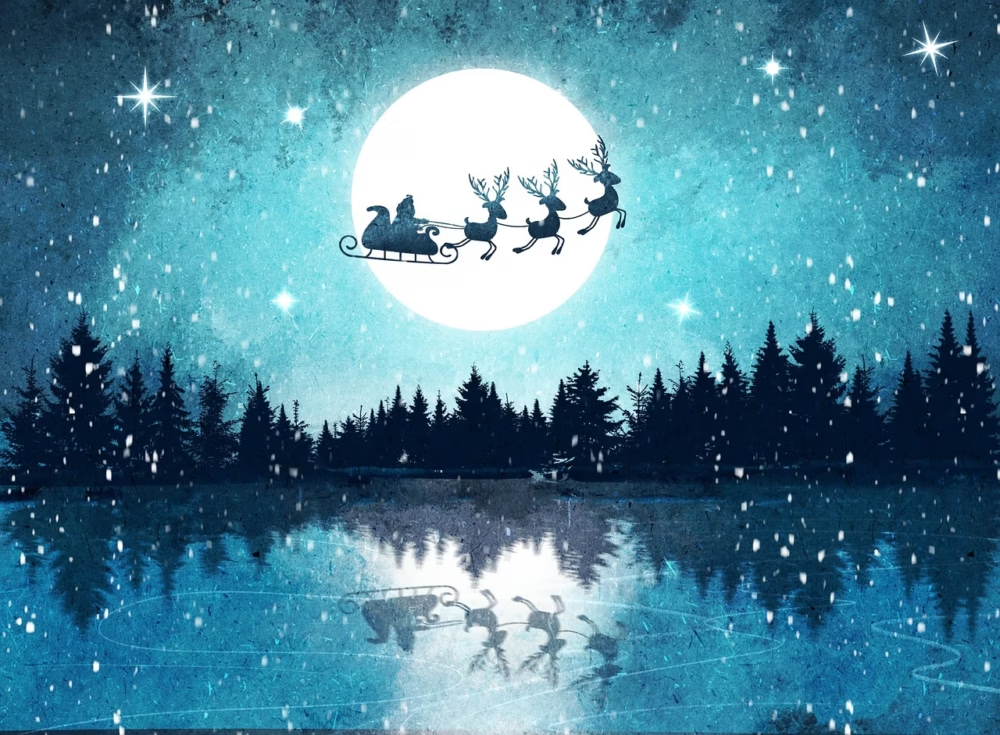

After years of helping businesses across the country become more sustainable, an energy efficiency expert has turned his attention to a very special client this Christmas: Santa Claus.
For centuries, jolly Saint Nick has delivered gifts around the world on Christmas Eve, powered by his trusted nine reindeer. But could he be even more efficient? Could the journey be cheaper, smoother, or kinder to the planet? That’s where energy efficiency expert Jamie Burns from Ailsa steps in.
“Santa, we’ve been investigating alternative fuel sources and energy-saving strategies for your global trip,” said Jamie. “With the right measures, you could save money, travel faster and lighten the load on your hardworking reindeer.”
What Jamie found:
“Santa’s sleigh currently relies on reindeer and magic dust. To make the initial leap from the North Pole, each reindeer needs around 24,000 kcal – six times their usual daily intake – adding up to 108kg of grain and a carbon footprint of 108kg CO₂e before Santa even reaches the first rooftop,” Jamie shared. “Keeping the team fuelled for the full world tour would require the equivalent energy of 8,600 carrots each, totalling 77,400 carrots – a further 972kg CO₂e. In total, a full Christmas Eve flight comes in at just under 1.1 tonnes of CO₂e. A theoretical switch to a cutting-edge electric sleigh, however, is far worse. With around 500 million homes on the “nice list,” the stop-start journey would demand roughly 2,400 GWh of energy – generating 1.14 million tonnes of CO₂e. That’s more than some countries produce in a week. Even with advances in green tech, nothing beats a motivated team of reindeer, a little magic dust, and a festive ho-ho-ho.”
Jamie’s 4 Ways Santa Can Boost Efficiency This Christmas:
- Streamline the sleigh weight
Weight is Santa’s biggest hidden energy cost. Switching to lightweight, recyclable packaging, digital gifts and e-cards, swapping traditional wooden toy casings for sustainable lighter composites, and pre-sorting gifts by region can help balance the sleigh more evenly. A well-distributed load reduces drag and means the reindeer need fewer calories to get airborne. We estimate even a 5-10% reduction in sleigh mass could shave hundreds of kilograms of required feed.
- Upgrade the sleigh’s aerodynamics
A full electric sleigh may be unrealistic, but aerodynamic improvements are an achievable middle ground. Santa could fit lightweight fairings, reduce decorative drag (streamlined candy-cane runners, slimmer sleigh rails) and apply low-friction coatings inspired by high-speed trains. Even minor design tweaks can reduce air resistance significantly at magical speeds, meaning the reindeer need less energy for the same distance – no extra magic dust required.
- Plan a smarter global route
Before take-off, Santa could use advanced route-planning tools to design a more efficient delivery path. By mapping global household density, clustering regions logically, and ordering continents in a way that avoids unnecessary backtracking, he can dramatically cut total distance travelled. Pre-planning around time zones, typical wind patterns, and expected weather systems would allow him to lock in a sleek, optimised route before he even leaves the North Pole – reducing strain on the reindeer from the very start.
- Use AI-assisted flight optimisation
Once in the air, an AI co-pilot could handle the moment-to-moment decision-making. The system would update Santa in real time on rooftop conditions, shifting wind speeds, optimal chimney sequences, and even regions where carrots are in short supply. Using this data, the AI could make micro-adjustments to speed, altitude, and short-term direction to maintain peak efficiency throughout the night – letting Santa focus solely on delivering gifts.
And What Can We Do to Help Santa?
“I recommend that children leave out energy-dense carrot snacks arranged in easy-grab bundles in the home, clearly labelled for the reindeer,” Jamie from Ailsa said. “Not only does this keep Rudolph and the team fuelled throughout the night, but it also prevents mid-flight hunger dips that can slow the sleigh down. For maximum efficiency, leave Santa’s mince pie and milk within arm’s reach of the fireplace to reduce his in-home travel time. Every second saved inside each house adds up when you’re visiting hundreds of millions of homes, so a well-positioned snack station can make a surprisingly meaningful difference to Santa’s overall delivery schedule.”

| [donate]
| Help keep news FREE for our readersSupporting your local community newspaper/online news outlet is crucial now more than ever. If you believe in independent journalism,then consider making a valuable contribution by making a one-time or monthly donation. We operate in rural areas where providing unbiased news can be challenging. |