












Deputy First Minister lends a hand collecting seeds on Wales’ biggest seagrass restoration project One million seeds will be collected off the North Wales coast as the pioneering project to improve marine life makes waves in tackling the global climate and nature crisis.
Seed collection begins on Wales’ biggest seagrass restoration project. With the support of local volunteers and the Deputy First Minister, approximately one million seeds will be collected off the North Wales coast. Launched in 2022, the Seagrass Ocean Rescue project aims to plant five million seeds across ten hectares, with the support of communities in Pen Llŷn and Ynys Môn by the end of 2026. Seagrass has the potential to play a vital role in our response to the climate and nature crisis.
Seagrass Ocean Rescue, managed by WWF in partnership with Project Seagrass, Swansea University, North Wales Wildlife Trust, and Pen Llŷn a’r Sarnau SAC, are working together with communities to deliver this ambitious seagrass restoration project in north Wales. The project is designed and delivered with the local community and the sites selected based on input from local people and ecological considerations.
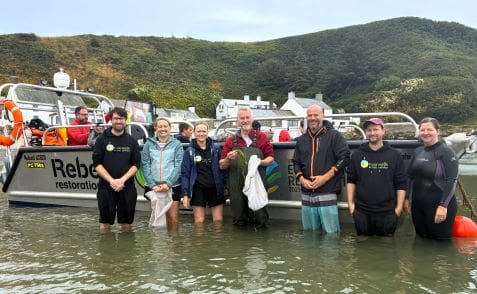
Deputy First Minister and Cabinet Secretary for Climate Change and Rural Affairs Huw Irranca-Davies lent a hand with the seed collection and visited the project on Tuesday 29th July to see the seed collection process in action. Seagrass Ocean Rescue are committed to working with Welsh Government and other stakeholders to see the delivery of a National Seagrass Action Plan that will help revive seagrass, protect our coasts, help create productive marine ecosystems and contribute to a sustainable economy whilst acting as a blueprint for future coastal restoration.
Thanks to National Lottery players the project was awarded a £1 million grant from The National Lottery Heritage Fund to carry out this work. Andrew White, Director of the National Lottery Heritage Fund in Wales joined in the seed collection on Tuesday (29th July) The National Lottery Heritage Fund is one of several funders which also include Garfield Weston Foundation and The Moondance Foundation. This month Seagrass Ocean Rescue will collect approximately 1 million seagrass seeds at Porthdinllaen with the help of local volunteers. The seeds collected this week will be planted at sites on Anglesey and Pen Llŷn with thanks to Stena Line for supporting and enabling planting in Holyhead.
The project was also joined by a representative for the Future Generations Commissioner for Wales who recognises the wider benefits of restoring seagrass and mobilising local communities to protect nature for people and society.
Deputy First Minister Huw Irranca-Davies said: “Restoring seagrass habitats in Wales is crucial for tackling the climate and nature emergencies so I was delighted to participate in this critically important work.
“Welsh Government funding is supporting collaborative efforts to restore 266 hectares of seagrass habitat, contributing towards our 30×30 conservation targets.
“I want to thank Seagrass Ocean Rescue partners and all volunteers for their hard work and dedication.”
Dr Richard Unsworth, Chief Scientific Officer at Project Seagrass, Assistant Professor Swansea University and Project Lead said:
“The work in north Wales is a critical part of a bigger vision for recovery of seagrass habitats across Wales. Wales has the expertise and opportunity to lead the way here. This project is supporting knowledge advancement for how we restore seagrass at scale.
“Restoration is hard, with continued effort required beyond specific project timeframes, but we know from the UK’s first successful meadow-scale project in southwest Wales, that it is possible. Collaborations like this, which significantly fed into the development of a Welsh Government endorsed National Seagrass Action Plan, are key to achieving ocean recovery.”
Penny Nelson, Ocean Restoration Advocacy and Policy Manager at WWF Cymru, said:
“It’s fantastic to see the Deputy First Minister get involved first-hand in this year’s seed collection. We hope to see commitment from this Welsh Government, and the next Welsh Government post-election in 2026 to fund and deliver a national seagrass action plan by 2030 which will see this incredible plant restored throughout our coast.
“Sadly, we have lost up to 92% of our seagrass in the UK. Whilst the north Wales project makes an important contribution to restoration efforts, seagrass meadows must be restored at scale so they can bring many benefits from tackling climate change and providing a home for marine wildlife to protecting our coasts and helping coastal communities thrive.”
Nia Hâf Jones, Living Seas Manager at North Wales Wildlife Trust, said:
“It’s great to see the seagrass seeds starting to take shape as meadows at our planting sites in north Wales. It is so rewarding to work with local people who are so passionate for seagrass and its conservation. So many young people and local community groups have been here in Porthdinllaen, year on year helping us collect seeds, and they will get to enjoy the benefits of their work for years to come.”
Andrew White, Director of the National Lottery Heritage Fund in Wales said: “It was an absolute pleasure to be a part of this important milestone for the Seagrass Ocean Rescue project and to see first-hand the beauty of these underwater seagrass meadows – truly breathtaking. I was also struck by the dedication shown by volunteers in planting, protecting and managing the seagrass habitats, and it’s wonderful that The National Lottery Heritage Fund can support this vital work, thanks to National Lottery players. Seagrass is one of our most important allies in carbon capture and climate mitigation – restoring these underwater meadows is essential for our planet’s future.”
Alison Palmer Hargrave, SAC Officer at Pen Llŷn a’r Sarnau, said:
“We’ve really enjoyed welcoming the Deputy First Minister to our seagrass seed collection week. His visit is a great opportunity to shine a light on the importance of seagrass restoration in supporting biodiversity, tackling climate change, and improving water quality. It’s also a chance to highlight the strength of collaboration behind this work.
“Local communities and volunteers are at the heart of this project. Their time, energy and local knowledge are invaluable, not only to the success of the seed collection itself, but in building long-term support for seagrass recovery in Wales. We’re incredibly grateful for their continued commitment and proud to be working alongside them to help protect and restore our marine environment.”
Derek Walker, Future Generations Commissioner for Wales, said:
“Conserving Wales’ seagrass is crucial for current and future generations; from protecting our coastline to removing harmful carbon from our atmosphere, and as a home to numerous species of marine wildlife.
‘This exciting programme is an example of hands-on action involving communities to fight the visible impacts of the climate emergency, as part of an ambitious and long term plan.
‘We need to maximise projects like this and save our precious seagrass meadows or risk losing some of Wales’ most iconic beaches’.
Seagrass has the potential to play a vital role in our response to the climate and nature crisis. Healthy meadows are critical for biodiversity, they provide nursery grounds for commercially important fish such as cod, and habitat for a range of species from octopus to seals. Seagrass is also important in tackling the climate crisis as it is very effective at absorbing carbon and healthy meadows can help protect communities from the impacts of coastal erosion and help improve water quality.

| [donate]
| Help keep news FREE for our readersSupporting your local community newspaper/online news outlet is crucial now more than ever. If you believe in independent journalism,then consider making a valuable contribution by making a one-time or monthly donation. We operate in rural areas where providing unbiased news can be challenging. |