
















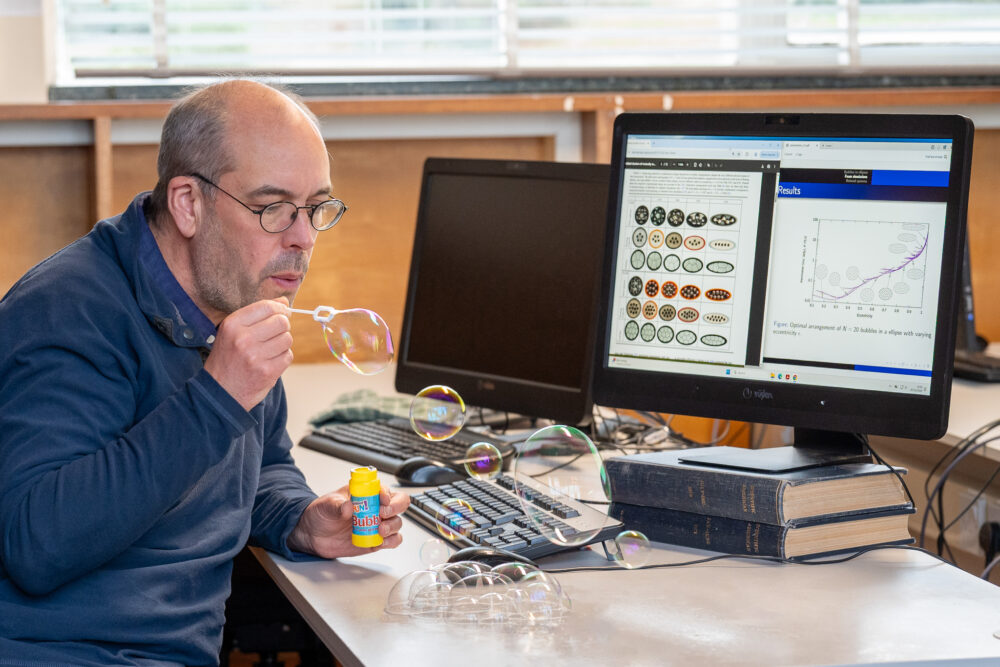

Particles as different as soap bubbles and ball bearings can be made to arrange themselves in exactly the same way, according to a new study that could unlock the creation of brand new materials — including those with promising biomedical applications.
The international study, involving Professor Simon Cox from Aberystwyth University, reveals how diverse particles self-organise into identical geometric patterns when confined.
The discovery could help scientists design advanced materials for medical use – including in smart drug delivery systems and targeted therapies. It could also offer valuable insights for tissue engineering where understanding how biological cells arrange themselves in tight spaces is essential for developing effective scaffolds and regenerative treatments.
The breakthrough was achieved using a simple mathematical model that balances two competing forces – how strongly the particles repel each other, and how tightly they are confined. By tuning these parameters, the scientists were able to predict and reproduce the same arrangements across a range of materials.
To test their theory, the team of researchers from the UK, Brazil and Ireland, performed experiments with floating magnets, ball bearings, and soap bubbles. Remarkably, despite their differences, the particles all settled into the same shapes when placed in carefully designed containers.
Professor Simon Cox, from Aberystwyth University’s Department of Mathematics, said:
“What’s fascinating is that discrete objects as varied as soap bubbles and magnetic particles can be made to behave in the same way, simply by adjusting how they are confined. It is a powerful reminder that nature often follows universal rules, even when the ingredients look completely different.
“It has been a privilege to work with this international team of scientists, tailoring our computer simulations of material structure to confirm the universality of the patterns seen in experiments.
“Understanding how particles self-assemble in confined spaces is valuable for the design of new materials with tailored properties, such as in biomedical engineering where it could help with developing treatments such as targeted therapies and smart or slow-release capsules. It could also benefit industry, helping with the packaging and transporting of granular materials such as powders, grains, or pellets.”
The research findings were published in the journal Physical Review E. The work was led by Dr Paulo Douglas Lima of the Federal University of Rio Grande do Norte in Brazil. The collaboration also included scientists from Trinity College Dublin and Technological University Dublin.

| [donate]
| Help keep news FREE for our readersSupporting your local community newspaper/online news outlet is crucial now more than ever. If you believe in independent journalism,then consider making a valuable contribution by making a one-time or monthly donation. We operate in rural areas where providing unbiased news can be challenging. |