









26% also believe claiming business miles will become significantly more difficult according to Venson research
New research[i] from Venson Automotive Solutions reveals that 62% of drivers say the introduction of Electric Vehicle Excise Duty (eVED) on electric cars will discourage them from switching, with almost a quarter (24%) confirming it will have a significant impact on their future purchase decisions. The findings come as the Office for Budget Responsibility warns that the new tax and other budget measures could reduce EV sales by 120,000 vehicles between 2025/26 and 2030/31[ii].
The new Electric Vehicle Excise Duty (eVED) is an extension of the current Vehicle Excise Duty (VED) regime and will take effect from April 2028. It will require drivers to record their mileage with the DVLA, providing both an odometer reading and an estimate of their mileage for the coming year, with the resulting eVED charge payable alongside their existing VED payment[iii]. Actual mileage will then be reconciled against this estimate, using MOT records where available. The system is forecast to raise £1.9 billion for the Exchequer in 2030/31[iv]. While almost a quarter of the motorists Venson surveyed support the introduction of eVED, 46% consider it unfair. 77% of Britons believe Britain is more divided than five years ago, YouGov poll finds
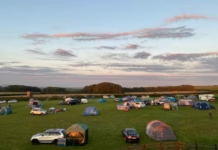
(Images / b-roll from previous conventions can be used, royalty free, here. Please credit to “Ahmadiyya Muslim Community”)
New YouGov polling also finds more than half (56%) of Britons believe the positive contributions of British Muslims are not widely known or recognised by wider British society.
More than three quarters (77%) of Britons believe the country is more divided today than it was five years ago, according to new YouGov polling commissioned by the Ahmadiyya Muslim Community.
The survey also found that 56% of respondents believe the positive contributions of British Muslims – such as charitable giving, volunteering and community service – are not widely known or recognised by wider British society.
The findings are released as the Ahmadiyya Muslim Community prepares to host Jalsa Salana UK, Britain’s longest-running Muslim convention, now in its 60th year. The event will bring together more than 50,000 Muslims from across the UK and around the world this weekend in Alton, Hampshire. The three-day event will feature keynote addresses from His Holiness, Hazrat Mirza Masroor Ahmad, Worldwide Head of the Ahmadiyya Muslim Community, and welcomes people of all faiths and none to attend, encouraging dialogue, understanding and stronger community ties.
At the start of the convention, the Union Flag is raised alongside the flag of the Ahmadiyya Muslim Community, reflecting the Community’s belief that loyalty to one’s country is part of the Islamic faith.
The polling also suggests many Britons believe the everyday contributions of British Muslims are not receiving wider recognition. Inspired by the Islamic principles of serving humanity and loyalty to one’s nation, the Ahmadiyya Muslim Community has raised tens of millions of pounds for charitable causes in the UK and around the world, while its members serve communities across Britain throughout the year. They organise charity walks, fundraising events, nationwide litter picks, New Year’s Day street clean-ups, tree-planting campaigns and regular food bank collections in communities across Britain, and volunteer countless hours to strengthen the communities in which they live.
Those efforts reflect the longstanding guidance of His Holiness, Hazrat Mirza Masroor Ahmad, Worldwide Head of the Ahmadiyya Muslim Community, who has said:
“Serving humanity is not a fleeting objective that comes and goes like the wind. Rather, it is a lifelong challenge – one that requires consistency and unshakeable steadfastness.”
His Holiness further stated:
“Rather than erecting walls that keep us apart, we should build bridges that bring us closer together.”
Reflecting on the findings, Usama Mubarik, an imam of the Ahmadiyya Muslim Community said:
“The findings of the poll are eye-opening. At a time when many people feel Britain is becoming more divided, the answer cannot be for communities to become more distant from one another. Dialogue is the antidote to division. That is why for 60 years, we have been welcoming people of all faiths and none to join us at the Jalsa Salana. Once you meet a Muslim, I’m sure you’ll find we have a lot more in common than you may have previously believed.”
Jalsa Salana UK takes place from 24–26 July in Alton, Hampshire. More than 50,000 people from over 100 countries are expected to attend the three-day convention, which is organised entirely by more than 5,000 volunteers.The new Electric Vehicle Excise Duty (eVED) is an extension of the current Vehicle Excise Duty (VED) regime and will take effect from April 2028. It will require drivers to record their mileage with the DVLA, providing both an odometer reading and an estimate of their mileage for the coming year, with the resulting eVED charge payable alongside their existing VED payment[iii]. Actual mileage will then be reconciled against this estimate, using MOT records where available. The system is forecast to raise £1.9 billion for the Exchequer in 2030/31[iv]. While almost a quarter of the motorists Venson surveyed support the introduction of eVED, 46% consider it unfair.

| [donate]
| Help keep news FREE for our readersSupporting your local community newspaper/online news outlet is crucial now more than ever. If you believe in independent journalism,then consider making a valuable contribution by making a one-time or monthly donation. We operate in rural areas where providing unbiased news can be challenging. |