











CHILDREN STILL LOVE TO IMAGINE BUT NEW RESEARCH REVEALS MANY FAMILIES HAVE LOST THE SPARK TO GET STARTED
Playmobil teams up with children’s author and presenter Maddie Moate and child psychologist Dr Amanda Gummer to help families rediscover imaginative, screen-free play over the summer holidays.
- Children are more than twice as likely to reach for a screen than make up a story when they’re bored, according to a new Playmobil study of 2,000 parents and 2,000 children.
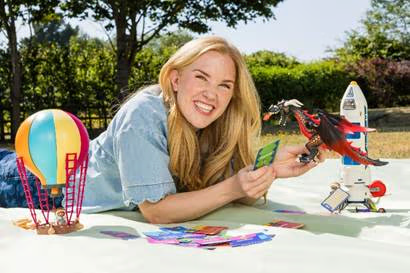
- Playmobil teams up with children’s author and TV star Maddie Moate and child psychologist Dr Amanda Gummer to launch free imagination prompt cards to help families rediscover screen-free play.
- Four in 10 children (38%) wish their parents would play with them more, while parents admit they often struggle to know how to get imaginative play started.
- Nearly nine in 10 parents (86%) say at least one toy or play activity their child once loved has been partly replaced by screens.
London, Tuesday 28th July – Children have more entertainment at their fingertips than any generation before them, yet new research from Playmobil suggests that always having something to watch, tap or scroll may be crowding out something more important: the ability to imagine from scratch.
The nationwide study1 of 2,000 parents and 2,000 children under ten suggests many families are experiencing what Playmobil calls the ‘Imagination Gap’ – the moment between having something to do and knowing how to turn it into creative play. To help families rediscover imaginative play, Playmobil has teamed up with children’s presenter Maddie Moate and child psychologist Dr Amanda Gummer to create a free collection of imagination prompt cards designed to turn “I’m bored” into stories and adventures.
The findings also show children are now more than twice as likely to reach for a screen when they’re bored as they are to make up a game, story or pretend world, with 28% saying they ask for or use a screen compared with just 12% who turn boredom into imaginative play.
According to the research, 86% of parents say at least one toy or play activity their child once enjoyed has been partly replaced by screens, including toy cars, trains, board games, puzzles, arts and crafts and imaginative play. Meanwhile, 60% believe they were more imaginative as children than today’s generation, while 75% say children now have less room to invent their own play.
Screens have become a holiday staple for many families, with 86% of parents relying on them to keep children occupied while they’re busy. At the same time, 27% of parents say their children spend three-four hours a day on screens during the holidays while they are working. Yet 54% of parents admit they feel guilty relying on them, while 74% wish their children spent more time playing imaginatively.
Parents also face increasing pressure from children asking for screens. Nearly a third (31%) say requests for phones, tablets or television make it harder to encourage imaginative play at home.
Despite the attraction of screens, children clearly haven’t lost their appetite for creativity. Nearly four in ten (38%) wish their parents would play with them more often.
Dr Amanda Gummer believes the findings show that children aren’t becoming less creative – they simply need more opportunities to practise their imagination. Parents recognise the challenge too: more than one in five (21%) say they run out of ideas for imaginative play, while 28% say the pressures of everyday life leave little time to join in.
Developed with Maddie Moate and Dr Amanda Gummer, each prompt card begins with an open-ended story starter, encouraging children to invent characters, solve mysteries and build adventures of their own with their toys. Whether it’s discovering why smoke is rising above a castle, solving the mystery of strange footprints outside a zoo or imagining where a rocket-powered fortress might fly next, the prompts give families somewhere to begin while leaving the story entirely in children’s hands.
The poll also offers an encouraging message with one in seven (13%) children stating they don’t think they’ll ever be too old for pretend games. Whether children love dinosaurs, rescue missions, fantasy adventures or everyday role play, there’s a Playmobil world to inspire every imagination. From much-loved themes including Space, Police, Fire, Zoo and Knights to hundreds of new launches, Playmobil gives families endless opportunities to create adventures at home, in the garden, on holiday or wherever the summer takes them.
Rooted in Playmobil’s belief that the best play happens when children lead the story, Playmobil’s huge range of toys gives them the freedom to create, collect and explore new adventures again and again – from travel-friendly figures and everyday role play to action-packed rescues, fantasy worlds and outdoor fun.
Maddie Moate, children’s author, presenter and parent said: “As someone who creates educational TV and online content for children and families, I appreciate the role screens have in our lives. But our most memorable moments happen away from them, when little ones are exploring, interacting and creating for themselves. Often, all it takes is a simple idea or prompt to unlock hours of imaginative play. Anything that helps families get started with playtime is a win in my book, especially at a time when so many parents are already balancing so much.”
Dr Amanda Gummer, research psychologist specialising in child development and founder of the Good Play Guide, said: “This research does not suggest that children have lost their imaginations. In fact, most children say they still make up games, stories or pretend worlds at least sometimes. The difficulty is that when boredom first appears, a screen is often the quickest and most familiar option, so children may have fewer chances to practise getting a story started for themselves.
“Imaginative play gives children room to experiment with ideas, language, roles and problems in a world they control. Boredom can provide the pause from which that begins, although some children will need a little support to cross that first hurdle.
“Parents do not need to ban screens or invent elaborate activities. A simple question, unusual prop or story prompt can be enough. Join in for a moment, then let the child decide what happens next. That small handover gives confidence, agency and imagination space to grow.”
Mitch Levene, Country Manager, at Playmobil, said: “Playmobil has always been about giving children the freedom to create their own stories. Whether it’s a pirate ship that’s suddenly sailing to the moon, a police officer solving a dinosaur mystery or a princess opening a beach café, our toys don’t tell children what to imagine, they give them the freedom to decide for themselves. Families will use these prompt cards alongside both new and much-loved Playmobil sets discovering just how much adventure can begin with a single idea.
Playmobil’s free Art of Storytelling prompt cards are available to download via www.playmobilartofstorytelling.com and pick up in participating stores, helping families turn everyday boredom into stories, adventures and imaginative play children can lead themselves.
Please find Dr Amanda Gummer’s expert analysis of the findings and top ten tips to on how to turn boredom into imaginative play here.

| [donate]
| Help keep news FREE for our readersSupporting your local community newspaper/online news outlet is crucial now more than ever. If you believe in independent journalism,then consider making a valuable contribution by making a one-time or monthly donation. We operate in rural areas where providing unbiased news can be challenging. |