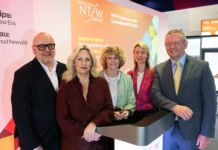



















Investment in workplace learning is the key to unlocking great careers, says trade union body
- TUC Cymru is calling for greater investment in workplace learning to help people progress in their careers.
- On 19 September, TUC Cymru celebrates 25 years of the Wales Union Learning Fund (WULF) – a Welsh Government-funded initiative that makes workplace learning fairer and more accessible – at the Senedd.
- WULF has led to tens of thousands of workers in Wales receiving training, health and wellbeing support and employability skills, with over 200 trade union-led projects spanning workplaces from Tata Steel and Dŵr Cymru to councils and health boards.
- WULF is worker-led, which has resulted in better outcomes for people less likely to engage in traditional post-16 education.
TUC Cymru is today [Thursday 19 September 2024] calling for more investment in workplace learning, as data shows a worrying decline training time for employees.
The call comes as the trade union body celebrates 25 years of the Wales Union Learning Fund (WULF) with an event at the Senedd. WULF is a Welsh Government-funded initiative which has transformed thousands of workers’ careers and lives, and created a culture of learning within workplaces.
ONS statistics show that – across the UK – the percentage of workers receiving job-related training has remained steady over the 25 years since WULF launched, standing at 16%.
However, more in depth analysis of in-work training in Wales by academics at Cardiff University found that workers were more likely to receive in-work training than their counterparts in other UK nations, but that there had been a fall in the intensity of training, meaning that the average length of time in training had declined.
Shavanah Taj, TUC Cymru General Secretary, said: “The trends for in-work training are concerning. Workers need this training to do their job confidently and well, so if less time is being spent on this it should ring alarm bells.
“The Wales Union Learning Fund addresses this by empowering workers to agree workplace training offers with their employer. This is what makes it unique – trade unions, on behalf of the workforce, are able to ensure that workers’ needs are also met by negotiating with bosses.
“This is why it has been very successful in creating workplace training offers that attract people who are less likely to participate in adult education, as well as those who face a greater risk of discrimination at work.”
Opportunities to progress
This chimes with the experience of Pru Orridge, an HMRC employee from Cardiff who joined the ‘Success Profiles’ course that was jointly funded by the FDA trade union’s WULF project and her employer. The course aims to improve opportunities for job progression by providing interview skills tailored to the civil service.
Pru originally joined HMRC as an administrative assistant in 2005. Helped by the training, she was quickly promoted to more senior roles. In 2021, she became the Customs Fraud Lead in the Fraud Investigations Service, an area of the civil service where ethnic minority workers are underrepresented.
Pru Orridge said: “I have absolutely benefitted from doing this training. As a result of the sessions, my interview skills are my strongest area. Thanks to the training, I know what my employer is looking for.”
For Pru, the training is also a great opportunity to build the confidence of underrepresented workers in the civil service, particularly for women and ethnic minority people in leadership roles.
Pru added: “As women we suffer from imposter syndrome, and this continues once you are in a leadership position. Once you have that confidence it makes such a difference.”
“The sessions have also been a great boost to race network members here in Wales. They have given members the skills to progress their careers. I am confident that we can move towards equality in the civil service.”
New skills
WULF has also led to workers in the social care sector gaining new skills. Care workers are being taught to use British Sign Language (BSL) through a new course delivered between UNISON Cymru/Wales’s WULF project and the care workers’ employer, Innovate Trust.
One care worker who took part in the BSL course said: “Since doing the course, I’ve been able to communicate better with the people I care for.
“With one man I support, you can see by the smile on his face, that he’s appreciative and he’s not feeling so isolated.”
Another participant said: “I wanted to do it because we have a lot of clients with hearing difficulties and speech impediments.
“This makes it difficult for them to be understood. It lets me speak to everybody that I wouldn’t normally be able to communicate with. I can have a proper conversation with them and understand exactly what they need and want.”
UNISON Cymru/Wales regional secretary Jess Turner said: “WULF plays a vital role in the development of workers across Wales and UNISON has always been at the heart of this.
“You only have to look at projects such as the award-winning course we ran with the Innovate Trust delivering British Sign Language to care staff to see how WULF has the power to transform the lives of public service employees and those they support on a daily basis.
“UNISON is honoured to be playing such a key role in WULF and we look forward to supporting the learning and development of many more workers in the years to come.”
Investment in workplace learning
Shavanah Taj said: “WULF evidently benefits workers, their employers and society more broadly. Welsh Government’s continued investment over the last quarter of a century is testament to this and their support for trade union-led learning.
“I am immensely proud of the difference that unions have made to so many workers’ lives through WULF. Investment in workplace learning through the union-led approach is the key to unlocking great careers. And with an increase in funding we could do so much more to transform workplace learning and people’s lives.”

| [donate]
| Help keep news FREE for our readersSupporting your local community newspaper/online news outlet is crucial now more than ever. If you believe in independent journalism,then consider making a valuable contribution by making a one-time or monthly donation. We operate in rural areas where providing unbiased news can be challenging. |