











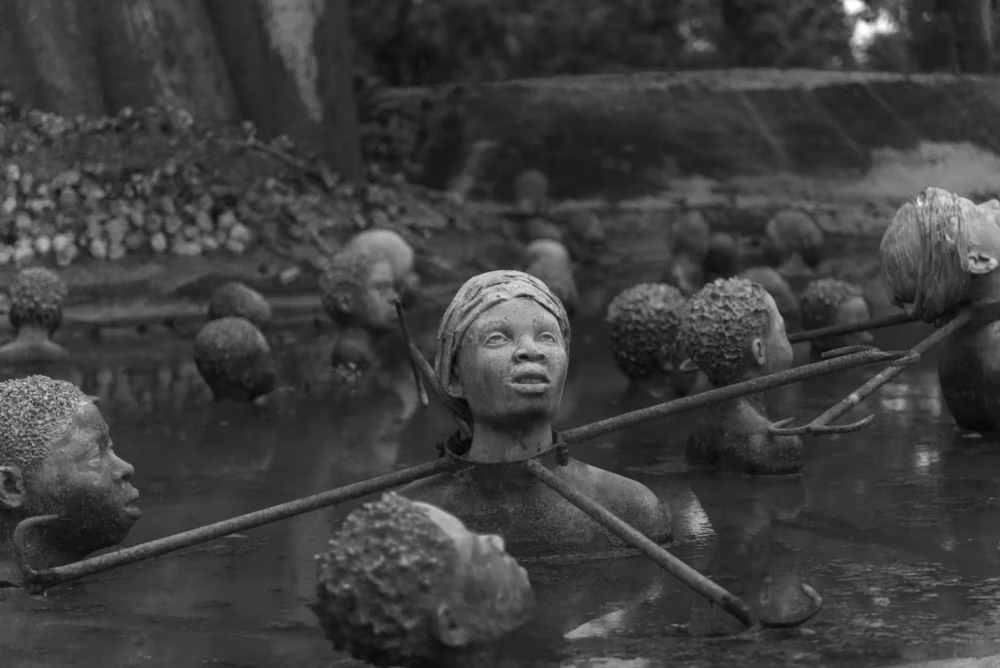

Professor David Olusoga has researched and followed how slavery made our elites rich in the 19th Century. There is this myth that Britain was not involved in Slavery and that we brought slavery to an end under the auspices of William Wilberforce. I wish it was that simple.
We were right in the middle of the slave trade and Bristol and Liverpool were built on the back of it. There is no pretending that we were so noble under the British Empire. We were utterly brutal and had no shame. George Canning ,a former nineteenth century Tory Prime Minister, after whom the East End of London area Canning Town is named, stood up in Parliament and said,
“In dealing with the negro, sir, we must remember that we are dealing with a being possessing the form and strength of a man, but the intellect only of a child.”
Kemi Badenoch, leader of the Tory party, obviously having done no research at all, has said; ”Britain led the fight to end slavery. We should not be paying for a crime we helped eradicate and still fight today”.
I find it extraordinary that the Tory party who dealt with helping to run the slave trade could be so blind and ignorant about what they did, man’s inhumanity to man.
From 1813 – 1840, the former British Enslavement Registers were created, covering Jamaica, Barbados,Trinidad, The Bahamas, Mauritius and the Cape of Good Hope. They started these registers to ensure that our slave traders, members of the royalty and the aristocracy would know who owned which slaves so there could be no illegal slave trading between them and that they could monitor ownership. Since then, there has been so much research led by Professor Olusoga so that now people can check their ancestry and recover their stories of resistance and freedom.
Another thing we are famous for is the Industrial Revolution but even that was based on the slave trade. An historian, researching the slave trade found the connections between the two,
“It could be reasonably argued it was the slave trade that made Britain the cradle of the Industrial Revolution.” This was due to supplying cheap raw materials. They also used the slave trade to generate investment capital and later on the system of slavery created the system of large overseas markets for manufactured goods. The Atlantic system which was tied to slavery in America developed our modern industrial growth. We were absolutely entrenched in the slave trade which has affected our present way of life.
The class system also developed through slavery. The aristocracy obviously benefited from property in the West Indies and therefore employed many slaves but in general there were unequal classes by those who accumulated slavery wealth and those who possessed only their labour and received wages but they were still not slaves as they were paid for their labour, however lowly the money was.
After the slave trade was stopped there are so many books which show how much compensation was paid. David Olusoga did a whole programme showing these amounts. Some were fairly small but of course the landowners and aristocrats were hugely reimbursed. All the ex-slaves in the Caribbean received nothing. They were badly paid, of course, but they were free, supposedly.
There was still, in the unequal society, the relics of slavery, the deserving and undeserving poor. The idea behind this was that if you didn’t work as hard as your bosses wanted you to, you were delegated while working for a pittance to the undeserving. If you worked like a slave for a pittance then you were the deserving poor.
Now we have the scroungers and the strivers or the illegal immigrants and indigenous labour.
So we always have someone to despise, after all we are better than everyone else, aren’t we?
Of course, we have our own slavers. Our local one is Thomas Picton, Carmarthenshire. There is a statue of him in the centre of Carmarthen and streets named after him. In Haverford West there is Picton Castle. He was a slave owner and slave trader. He believed in torturing slaves. He is famous for his brutal treatment of the people of Trinidad. He was the most senior man to die at Waterloo and he was also a sitting Member of Parliament at the time. I personally demonstrated in Carmarthen to take the statue down but unfortunately, the statue still stands.
Another famous slave trader and merchant is Edward Colston in Bristol. Bristol was built on the slave trade and because of the money he made on the slave trade he was able to be a famous philanthropist in Bristol with monuments built in his honour. He was a member of the Royal African Company which held a monopoly on the west coast of Africa, trading in slaves. The governor of this company was the Duke of York, brother of Charles II of England. In the late twentieth century, the local citizens of Bristol were ashamed of his notoriety and since then monuments and street names have either been changed or removed including the famous Colston statue.
The Enslavement register that was created , the British Caribbean and British Colonial World, set out all the information about how British slavery was run and how much money was made. Many stately homes in Britain today are still supported by slavery history. British Slave Traders continued to make millions. They were compensated, millions of pounds in today’s money while the enslaved got nothing.
Many Tory MPs in our parliament today are seriously rich because of their links to the slave trade.
Our country has a great deal to answer for due to our disgraceful British Empire. History teachers need to tell the truth about what we did all over the world. Hitler admired it and wanted to join up with us in the Second World War but luckily our government at that time could never have been allies with the Nazis.

| [donate]
| Help keep news FREE for our readersSupporting your local community newspaper/online news outlet is crucial now more than ever. If you believe in independent journalism,then consider making a valuable contribution by making a one-time or monthly donation. We operate in rural areas where providing unbiased news can be challenging. |