















Wave curtains have a reputation for looking effortless, and in a well-planned room they do. The soft, even S-shaped folds run from one end of the window to the other and keep their shape whether the curtain is closed or drawn back. That tidy finish is not an accident, though. It depends on three decisions made before anything is ordered: the fabric, the track it hangs from and the amount of space left at the sides for the curtain to stack. Get those three right and the curtains look as though they belong in the room; get one wrong and the waves can look flat, crowded or simply too heavy for the opening. This guide walks through each decision in the order a fitter would raise them, with London homes in mind, where windows range from tall sash frames to wide glazed extensions.
Why wave curtains suit London homes
London properties rarely have a single, standard window. A Victorian terrace may have tall, narrow openings on the front and a wide set of doors at the back, while a new-build flat might offer floor-to-ceiling glazing from one wall to the other. Wave curtains cope with that range because the heading produces the same regular folds on a narrow window as it does across a large glazed wall.
The second reason is the slim profile. Unlike a pinch pleat or pencil pleat heading, a wave heading does not bunch the fabric at the top, so the curtain hangs directly beneath the track. In a smaller room this matters, because the curtain takes up less depth and sits closer to the wall when it is open.
The look is also deliberately calm. The folds are uniform, which suits contemporary living rooms, dining areas and open-plan spaces where a busier heading would compete with other details. If your home has a more traditional character, wave curtains in a textured or patterned fabric can still sit comfortably, as the shape stays simple while the cloth does the talking.
How the wave heading is formed
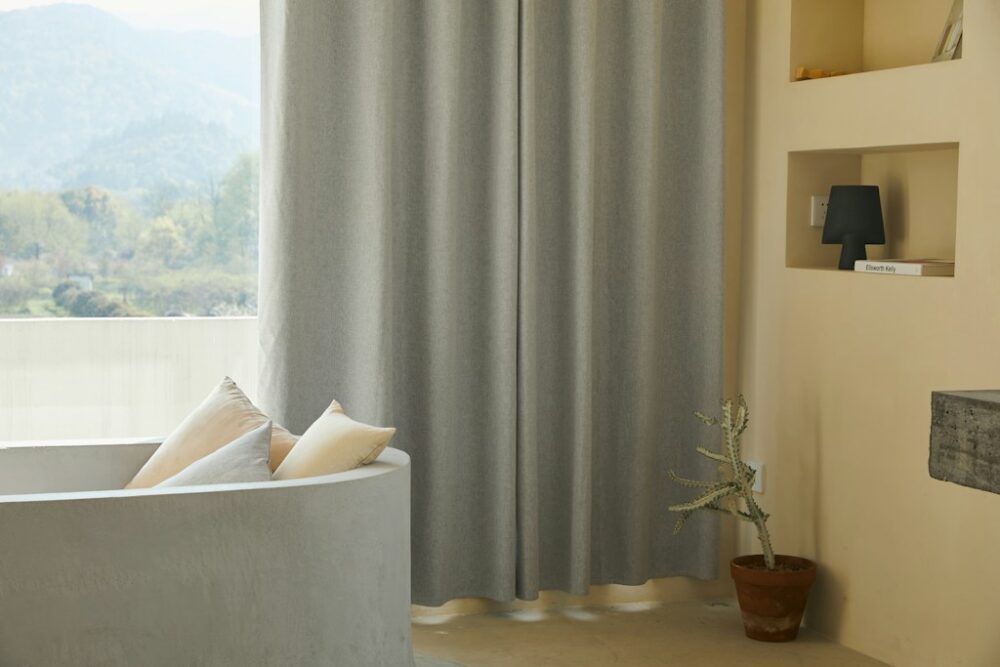
The folds come from a specific heading tape that clicks onto the gliders of a dedicated wave track. A cord hidden inside the track connects the gliders at fixed distances, and that fixed spacing is what produces the evenly spaced S-shaped waves. Because the spacing is set by the hardware rather than by someone pulling the fabric into shape, the result repeats consistently along the whole curtain.
This is why wave curtains cannot simply be hung from a standard pole and rings. The tape needs the glider system to hold the folds, and the track needs to be level for the waves to line up. A track that is even slightly out of true will show as a drift in the folds, which is one of the reasons professional fitting is worth considering for this style.
It also explains the stack behaviour. The same hidden cord that sets the wave depth keeps the fabric from overstretching or bunching unevenly as the curtain moves. When the curtain is drawn open, it should stack back neatly and compactly without being dressed by hand, which is a practical advantage in rooms where curtains are opened and closed every day.
Choosing fabric and lining
A useful point about this heading is that the folds stay uniform regardless of how thick the material is. Lightweight, semi-transparent fabrics work, as do heavier blackout materials. That gives you the freedom to choose by purpose first and appearance second, rather than avoiding certain cloths because they will not pleat properly.
Before you choose, it helps to match the cloth to the room:
- Living rooms: a medium-weight fabric in a soft texture tends to look best, because it holds the waves without looking stiff.
- Bedrooms: a heavier or blackout-lined fabric helps with light control, particularly on the east side of the house where early sunlight is strong.
- Rooms with glazed doors: a lighter fabric keeps the opening feeling open, while a lined version gives more privacy in the evening.
- Sunny rear extensions: a fabric with some weight in the weave can reduce glare, though the track and fullness matter just as much as the material.
None of these is a rule, and the same room can be dressed in different ways. The point of the list is to separate what the curtain must do (block light, add privacy, soften sound) from how it should look. Once the function is clear, the fabric choice becomes much easier, and the fitter can advise on the lining that suits it.
The track: what it has to do
The track is the part nobody sees but everybody notices if it is wrong. For wave curtains it has to be a dedicated wave track, supplied and installed so that it sits level, carries the weight of the fabric and keeps the gliders at their fixed spacing. A slimline version can be top-fixed into a ceiling recess, which gives a floating effect where the curtain seems to hang from the ceiling itself.
Motorised tracks are also an option, operated by remote or through a smart home system, which is helpful for very wide or high windows where pulling a curtain by hand is awkward. If you want to see how this made-to-measure service works in practice, the details of the range are set out at https://kellysblinds.co.uk/curtains/wave-curtains/, including the four stages from consultation and quote to measuring, making and fitting.
When comparing tracks, ask about the ceiling or wall fixing, the weight the track can take and how the curtain will behave at the point where it meets the wall. A wall-fixed track gives a visible line and can be a good match for a decorative interior, while a recessed ceiling track keeps the lines minimal. Neither is better in the abstract; the choice depends on the plaster, the ceiling height and the look you want.
Planning fullness and stack width
Wave curtains need a specific amount of fullness for the waves to form properly. The supplier does not publish a single figure, and it can vary with the fabric and the make. As a general guide, many makers work with a multiple of roughly 1.8 to 2 times the track length, and a good general rule for any gathered curtain is that the fabric should be about twice the width of the window. Confirm the exact multiple with your fitter, as it affects both the look and the stack.
Stack width is the space the curtain occupies when drawn open, and it is where many rooms go wrong. A curtain that stacks across the glass will block light and make the window look smaller. The usual remedy is to extend the track beyond the window frame on each side, and a commonly cited range is 15 to 30 cm so the fabric can sit on the wall rather than the glass.
As an illustration with round numbers, imagine a window frame 2.4 m wide. Extending the track by 20 cm each side gives a track of 2.8 m, and fabric at roughly twice that length comes to around 5.6 m. These figures are only an example, but they show why wide windows need careful planning: the fabric quantity and the stack both grow quickly, and heavy, lined cloth takes more room than a light one.
Measuring up before the survey
You do not need to measure everything yourself, because a professional fitter visits to take precise measurements. Even so, a rough set of figures helps you plan the room and have a more useful conversation at the consultation. A metal tape is more reliable than a cloth one, since cloth can stretch, and a step ladder helps on taller windows.
Think about the drop as well as the width. Decide whether the curtains should fall just below the sill or to the floor, and how far above the frame the track will sit. Good general advice on these proportions, including how high to hang a pole or track and how far to extend it, is collected in https://kellysblinds.co.uk/all/how-to-hang-curtains-like-a-designer-tips-for-a-stunning-look/, which is useful background even though a wave track replaces the pole.
It is also worth noting what is in the way. Radiators, window sills that project, sockets and blinds already in place can all affect the drop and the stack. Mentioning them at the quote stage saves a second visit and lets the fitter suggest the cleanest arrangement, such as a floor-length curtain that clears a radiator or a shorter drop where furniture sits beneath the window.
Where wave curtains work best
Wave curtains are most convincing on large windows and glazed openings: patio doors, bi-fold doors, floor-to-ceiling panels and the generous glazing of modern extensions. In a London loft with a high ceiling, a full-height curtain on a ceiling-recessed track can add to the sense of scale, since the folds draw the eye up and the track disappears from view.
They also work in ordinary rooms. A 2.7 m ceiling is common in many London flats, and a floor-length wave curtain on a slim track can make that height look deliberate. In a bedroom, the same heading in a lined or blackout fabric gives a clean, hotel-style finish that still performs the practical job of keeping out morning light.
Where they work less well is at windows that need to open inwards across the curtain line, or tight recesses that leave no room for a stack. In those cases a blind, or a simpler heading, might be a better answer. A good fitter will say so during the survey instead of forcing the style onto the wrong opening.
Waves that stay in shape
The curtains that look best a few years in are usually the ones planned most carefully at the start. Choose the fabric for what the room needs, accept the track as part of the design rather than an afterthought, and leave enough space at the sides for the stack to sit clear of the glass. With those three decisions made, the waves tend to look after themselves, and the professional fitting, testing and tidying up that finish the job leave you with a window that is both calm and practical.
Frequently asked questions about wave curtains
Can wave curtains be hung on a normal pole?
No. The heading tape clicks into the gliders of a dedicated wave track, and that track is what creates the even folds. A standard pole and rings cannot hold the waves in place, so the track is supplied and fitted together with the curtains.
Do wave curtains work with blackout fabric?
Yes. The heading produces uniform folds across both lightweight, semi-transparent fabrics and heavier blackout materials, so you can choose the cloth for its function. Heavier, lined fabric will stack wider, which is worth allowing for when you plan the track length.
How much wider than the window should the track be?
A commonly cited range is 15 to 30 cm on each side, so that the open curtain rests on the wall rather than covering the glass. Your fitter can confirm the right figure for your fabric and room at the measuring visit.
Are motorised wave curtains available?
Yes. Motorised tracks can be operated by remote or through a smart home system, which suits wide, high or hard-to-reach windows where pulling the curtain by hand would be awkward.

| [donate]
| Help keep news FREE for our readersSupporting your local community newspaper/online news outlet is crucial now more than ever. If you believe in independent journalism,then consider making a valuable contribution by making a one-time or monthly donation. We operate in rural areas where providing unbiased news can be challenging. |